 In February 2026 we presented the all-new Wolves Upon the Coast Bundle featuring the Wolves Upon the Coast Grand Campaign, a bare-bones old-school hexcrawl campaign by designer Luke Gearing. Your history is gone. It was taken from you, or you from it. You were thralls. Now your master lies dead in the bottom of a raiding vessel, equipped for adventure. You are free.
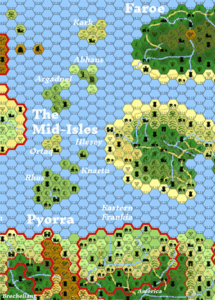
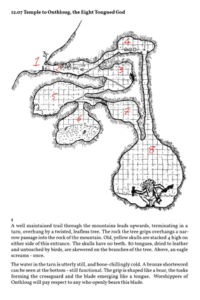
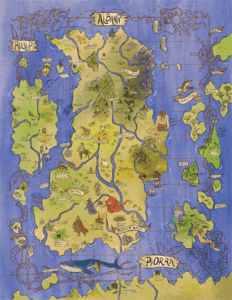
That’s the entire setup for this tersely written, simply presented, yet sweeping sandbox campaign, one of the most widely praised creations in the Old School Revival community. The 51×32-hex Wolves Upon the Coast color map details the islands of Ruislip, Albann, and Noos, along with an island chain known as the Mid-Isles, the peninsula of Faroe, and much of the mainland, Pyorra – about 540 keyed hexes, roughly akin to Northern Europe in what used to be called the “Dark Ages.” Aside from the map and some dungeons, there is no art; the layout is plain text, spartan as a Word document, and production values are, shall we say, clean. (Download the free demo file from itch.io to see what you’re getting.)
 There’s no introductory scenario to onboard you in this bleak, mythic low-magic world. You generate characters using old-school rules adapted from Original D&D, grab an equipment package from the quickstart list, and then sail – well, wherever you want, whatever direction the wind takes you, whichever hex is next in this massive hexcrawl challenge. The map is dense, and every hex yields something interesting.
 The unforgiving environments in Wolves Upon the Coast, and their trappings of early medieval Northern Europe – mud, wolves, saints, curses, petty kings – foster a tone of tragedy and moral messiness without turning grimdark. The Referee prepares, not stories, but situations. Player characters inevitably tangle themselves in the agendas of kings, cults, bandits, and monsters. In this lethal world where they must earn every success, players discover their own story. Across a long open-ended campaign, chronicling a procession of burned villages, betrayed kings, and cursed bloodlines, the characters’ actions can change the setting.
Wolves Upon the Coast uses its own spare, almost schematic old-school rules system derived from Original D&D. There are no classes, levels, or mental statistics. Advancement is based on boasts: Make a boast and fulfill it to gain a permanent bonus to Hit Dice. The rules work best for experienced Referees ready to make rulings in unusual situations.
Luke Gearing’s pointedly concise descriptions fill Wolves Upon the Coast –
This small isle is thick with hypertrophied vegetable growth. The plants lean eagerly towards Ruislip, leaves extended like fingers.
Those sleeping here are strangled in the night by the plants, loving coils around necks. In the years to come, they awake as if from a dream, skin of bark, legs all root and leaves fat and green.
Those bringing a victim here and watching them be consumed overnight may entreat a Subtle Spirit, who demands one such sacrifice a month. Without such a sacrifice, the spirit inhabits the nearest corpse and hunts the sorcerer – fighting as a Wraith, but gaining +3HD in sunlight.
– and such descriptions especially fill the campaign’s companion monster and treasure books, going beyond “succinct” and verging on “Delphic”:
GOBLINS
HD 1-1
AC as Armour
Damage as Weapon
When a city dies, the children survive.
They do not survive unchanged.
That’s it, that’s the whole Goblin entry. You already know what a goblin is, so Luke just hints how they differ in this world. The monster book entries are baselines, and each individual encounter in the campaign modifies them somehow – though never with verbosity. A Referee engages with these texts, studies them like Norse sagas. The Wolves postscript reads, in its entirety, “The great tool of Creation is the knife.”
 Wolves Upon the Coast was a passion project for Luke Gearing, who designed Acid Death Fantasy and others for Troika, Gradient Descent for Mothership, Rainmaker for Salvage Union, Fever Swamp, and many others. “I’ve loved writing Wolves, […] a pretty firm statement around my beliefs that content trumps everything else,” he wrote in an August 2022 retrospective blog post. “Hexcrawls have always been one of my favorite tools of play, and getting to do one on this scale is a delight. Money aside, please write your big unreasonable project. You will enjoy it if no one else does, and you might be surprised who else wants to come along for the ride.”
Many reviewers have praised Luke’s big unreasonable project. In April 2023 a redditor on the r/osr subreddit gave his thoughts after “Eight months playing West Marches Wolves Upon the Coast“: “You’ve got truly great random encounter tables. You’ve got a variety of ships with different speeds and mobility. Perhaps most important, you’ve got a wind and weather system that really matters. And all these systems work together harmoniously to bring true depth. Everything rides on the clockwork cohesion of random encounters, random distance, random reaction, clean hexcrawling rules, and a great map. […] There are titanic moving statues, a (hidden) questline about finding Lemuria, multiple entries on the encounter table that tell you ‘A hexcrawl appears’ (and the hexcrawl is already written for you! It’s in the book!), murdered godlings, and dragons dreaming golden dreams on vast hoards. You can become an ogre, a troll, or a harpy. You can lead armies and die of starvation on an uncharted island after a storm.
 “This game has everything. It’s got the wonder of OD&D and the campaign-level ambition of AD&D. It pulls it off with aplomb. My players have visited (not explored, mind you, just visited) less than 10% of the map. We’ve been playing weekly for eight months. We might play for many years more. Wolves Upon the Coast is a masterpiece. It is one of the best things to come from the OSR.”
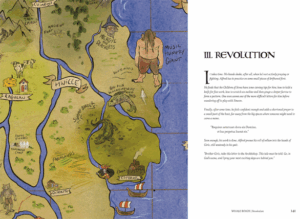
A Referee named Adam ran Wolves Upon the Coast in 2024 and started a blog specifically to gush: “Wolves is probably my favorite published setting of all time. My complaints about it are fairly small and are generally more personal preference than anything. If you don’t absolutely require large amounts of art, and you can spare the money to buy this, it is a must-have for every digital library.”
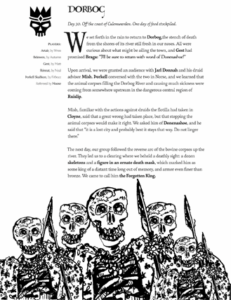
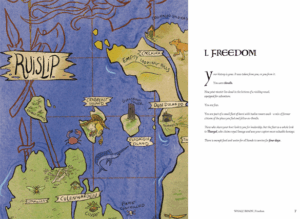 This all-new Wolves Upon the Coast Bundle featured this must-have campaign for an unbeatable bargain price. There were three titles in our Wolves Collection (retail value $71) as DRM-free .PDF ebooks, including the complete 355-page Wolves Upon the Coast Grand Campaign and its eccentrically-named companion supplements, Monsters & and &&&&&&&&& Treasure. As a convenience, or actually as a tantalizing appetizer, we included the free Whale Roads, a remarkable fan-produced journal that recounts a year-long Wolves campaign played by three dozen players under three Referees. This lavishly produced account, as much as anything else, will excite you to try Wolves Upon the Coast yourself.